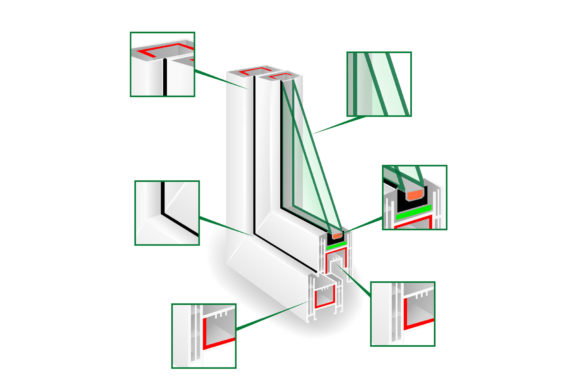
The Essentials of a Plastic Window Frame Profile
In design, manufacturing, and construction, precision is paramount. A Plastic Window Frame Profile is a digital template, typically created as a vector graphic, that provides the detailed outline and structural dimensions for a plastic window frame. This profile serves as a standardized blueprint. For many, it's a foundational asset, much like a pattern for a tailor or a schematic for an engineer. Understanding its form and function unlocks its potential for a surprisingly wide range of projects and professions.
If you are sourcing or specifying window components for a renovation, this profile defines the exact shape and cross-section of the frame extrusion. For a graphic designer working on a home improvement brochure, it's a clean, scalable graphic element. For an entrepreneur creating a DIY window assembly guide, it becomes a crucial visual aid. Its value shifts dramatically depending on who is using it and why.
Beyond the Blueprint: Why This Profile Matters
At its core, a Plastic Window Frame Profile provides clarity and consistency. It removes ambiguity about dimensions, angles, and structural features. This isn't just about a picture; it's about accurate data presented visually. Whether the final format is a JPG for a quick reference image or an EPS vector file for infinite scaling without quality loss, the profile translates technical specifications into a universally understandable form.
A marketing professional at a window manufacturing company might use this profile in a technical catalog to show product superiority. A hobbyist building a model might use it to ensure scale accuracy. An educator teaching basic architectural principles could employ it as a real-world example of component design. The same file—a Plastic Window Frame Profile—serves these different purposes because it acts as a reliable, neutral source of information.
For Professionals and Business Owners: Precision and Presentation
In commercial and industrial contexts, the priority is often reliability, quality, and commercial value. An architect or construction manager evaluates a Plastic Window Frame Profile for its technical accuracy and completeness. Does it correctly show the thermal break? Is the glazing channel depth specified? This detail directly impacts project planning, material sourcing, and cost estimation. Inaccuracy here can lead to real-world installation failures.
For a small business owner in the window supply trade, such a profile is a sales and communication tool. Providing a clear, professional EPS vector graphic to clients demonstrates expertise and helps avoid misunderstandings. The long-term usefulness is in streamlined operations and enhanced client trust. Their evaluation focuses on how the profile improves process efficiency and supports the E-E-A-T principles—Experience, Expertise, Authoritativeness, and Trustworthiness—of their own business content.
For Creators, Educators, and Freelancers: Flexibility and Creativity
This audience looks at the profile through a lens of creativity, learning value, and flexibility. A freelance illustrator tasked with creating an infographic about window efficiency needs a clean, editable vector (EPS) to integrate into their design. Their priority is ease of use within their software (like Adobe Illustrator) and how well it can be styled to match a brand's visual identity—without distorting its fundamental accuracy.
An educator or blogger developing a tutorial on home insulation uses the profile as an educational scaffold. They might simplify a complex JPG version to highlight key features for beginners. Their goal is to make a technical subject accessible. The profile’s value lies in its ability to be adapted for explanation, serving readers who need to understand concepts rather than manufacture parts.
For Beginners, Hobbyists, and Consumers: Clarity and Practical Insight
If you are a consumer planning a window replacement or a beginner in DIY projects, your needs are practical and personal. You might encounter a Plastic Window Frame Profile in a product manual or a supplier's website. For you, it helps visualize what you're buying. You can see the frame's thickness, how it might look installed, and understand terms like "frame profile" that salespeople use. Your evaluation is about clarity: Does this graphic help me make a better decision? Does it demystify the product?
A model-making hobbyist, for instance, might use a scaled-down version of such a profile to create realistic window frames for a diorama. Their priority is the profile's accuracy as a reference to achieve a realistic outcome, even if they are not using the digital file directly. For them, it's a guide to craftsmanship.
Aligning the Profile with Your Specific Goals
How do you know if focusing on a Plastic Window Frame Profile is right for your project? Start by asking about your intent.
- Is your need technical or communicative? If you require exact dimensions for fabrication or quality control, seek a high-detail vector (EPS) profile from a technical source. If you need to explain or market a concept, a well-rendered JPG might suffice.
- What is your skill level with design tools? Beginners may prefer ready-to-use JPG images. Creators and professionals who need to customize will require the editable EPS format for its flexibility.
- Is the end goal commercial, educational, or personal? A manufacturer needs profiles that underscore precision for B2B sales. An educator needs profiles that simplify for learning. A homeowner needs profiles that clarify for personal purchase decisions.
Consider a blogger writing about sustainable building materials. They could use a Plastic Window Frame Profile to compare traditional and modern frame designs, highlighting material thickness and insulation spaces. Their use is explanatory, adding authority to their content. Meanwhile, an entrepreneur launching a line of custom window inserts would use the same profile type as a production template, where precision directly affects product viability and cost.
Practical Examples in Action
Let's look at two distinct applications. A professional contractor is preparing a bid for a commercial building retrofit. They acquire an accurate EPS vector profile of the specified window system. They use it to generate precise cut lists and material estimates, ensuring their bid is competitive and realistic. The profile here is a core operational asset.
Conversely, a marketer at a small design firm is creating a one-page flyer for a local window installer. They find a clean JPG of a Plastic Window Frame Profile. They incorporate it as a background graphic element to evoke the industry, adding visual credibility without deep technical detail. Their priority is speed and presentation, not manufacturing precision.
Ultimately, the significance of a Plastic Window Frame Profile is defined by the person using it. It can be a hard-edged technical specification, a soft-focus visual aid, or a learning bridge between complex engineering and everyday understanding. By recognizing your own role—whether you are a professional seeking reliability, a creator needing flexibility, or a consumer wanting clarity—you can determine how this simple yet powerful template fits into your work and helps you achieve your specific goals, from building a house to building a website.